Have you ever stepped on a scale, punched your numbers into a basic BMI calculator, and felt… unsatisfied? Like that single number couldn’t possibly tell the whole story of your health? You’re absolutely right—it doesn’t.
🤖 AI BMI Calculator
Get instant BMI with intelligent health guidance
Click "Calculate with AI" to receive your personalized wellness guidance.
Welcome to the era of the “AI BMI Calculator”, where technology meets holistic wellness, and where a number transforms into a conversation about your unique health journey.
What Exactly Is BMI and Why Does It Need an AI Upgrade?
Let’s start with the basics. Body Mass Index, or BMI, is a simple mathematical formula that has been used for nearly two centuries to categorize individuals based on their height and weight:
BMI = Weight (kg) ÷ Height (m)²
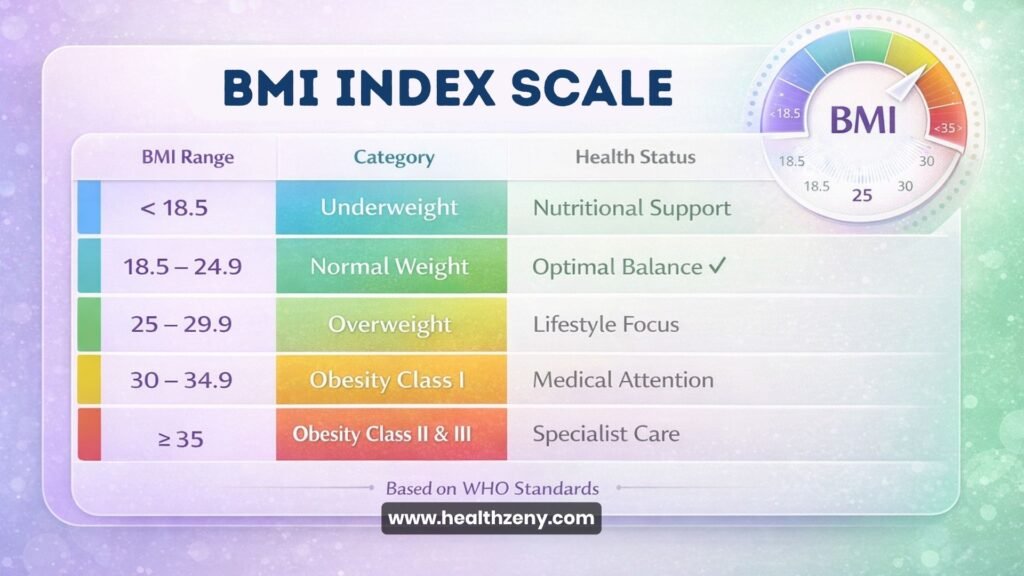
The World Health Organization (WHO) classifies results into standard categories: underweight (below 18.5), normal weight (18.5–24.9), overweight (25–29.9), and obese (30 and above) .
But here’s the catch- BMI was introduced in the 1830s as a population-level statistical tool, not as a personalized health assessment . It was never designed to distinguish between fat and muscle, bone density, or the nuanced differences between individuals.
And that’s precisely where the AI BMI Calculator changes the game.
The Problem with Traditional BMI (Spoiler: It’s Not You, It’s the Math)
Before we dive into the AI-powered solution, let’s be honest about what traditional BMI gets wrong—because understanding these limitations helps us appreciate the upgrade.
1. It Can’t Tell Muscle from Fat :
This is the biggest flaw. A bodybuilder with 8% body fat and a sedentary individual with 35% body fat could have the exact same BMI. Does that mean their health status is identical? Absolutely not .
Consider this: a cross-sectional study of over 13,000 participants found that while BMI classified 21% of men and 31% of women as obese, bioelectrical impedance analysis (BIA) revealed that **50% of men and 61% of women** actually qualified as obese by body fat percentage .
That’s a massive gap. Nearly half of people with excess body fat are walking around thinking they’re “normal weight” according to BMI alone.
2. Athletes Get Penalized:
If you’re muscular and active, BMI might label you “overweight” or even “obese.” Professional athletes regularly fall into these categories despite having optimal body composition. Your muscle mass is a health asset—not something to be penalized by a 19th-century formula .
3. It Misses Hidden Health Risks :
Here’s something that might surprise you: a person can have a “normal” BMI and still carry dangerous levels of visceral fat—the fat stored around internal organs that’s strongly linked to heart disease and type 2 diabetes. This condition, sometimes called “normal-weight obesity” or sarcopenic obesity, affects millions and flies completely under the radar of traditional BMI .
4. Age and Ethnicity Matter:
As we age, we naturally lose muscle mass (a condition called sarcopenia). An older adult might have a “normal” BMI but dangerously low muscle mass and high body fat. Similarly, body composition varies across ethnic groups—meaning the same BMI number can mean different things for different people .
What Makes an AI BMI Calculator Different?
So if traditional BMI has these limitations, why bother with it at all? Great question. The answer is that BMI remains a valuable screening tool-it’s quick, accessible, and free. The AI upgrade doesn’t discard BMI; it contextualizes it.
1. Personalized Insights, Not Just a Number
A traditional calculator tells you your BMI is 27. An AI BMI Calculator tells you:
– What that number means for your body type.
– Whether your muscle mass might be affecting the reading.
– Practical, actionable steps based on your specific result.
2. Integration with Holistic Health Principles
Modern AI-powered tools draw from multiple health frameworks. Some integrate Ayurvedic principles -like the one we’ve developed- that consider not just your numbers but your body’s unique constitution (Doshas), digestive fire (Agni), and the quality of your tissues (dhatus) .
Research published in the National Institutes of Health (NIH) database shows that Ayurvedic approaches, when combined with lifestyle modifications, can produce meaningful changes in anthropometric measurements and metabolic health markers .
3. Better Than Self-Reporting:
Did you know that when people self-report their height and weight online, they tend to overestimate height by about 1.36 cm and underestimate weight by about 0.55 kg? Research from the University of Newcastle confirms this pattern, which can misclassify BMI categories entirely .
An AI BMI Calculator with proper input validation helps minimize these errors.
4. Connects the Dots Between Different Health Metrics :
Your BMI doesn’t exist in isolation. AI-powered tools can help you understand how your weight relates to other health indicators- like waist circumference (a key marker of visceral fat risk), body fat percentage, and even your unique lifestyle factors .
The Science Behind AI-Powered Body Analysis
Let’s get a little technical- but stay practical. Modern AI health tools don’t just crunch numbers; they use sophisticated approaches to give you meaningful insights.
1. The CHi (Comprehensive Health Index) Approach :
Some advanced tools now use a Comprehensive Health Index that goes far beyond the scale. The CHi system analyzes multiple body measurements-waist, hip, neck, height, and weight-to assess three critical pillars of health:
– Visceral Fat Risk (WHR) : Assesses dangerous fat around your organs.
– Body Fat Percentage (BFP) : Pinpoints the true ratio of fat to lean mass.
– Muscle Mass Potential (MMP) : Measures strength and identifies risk of age-related muscle loss.
2. How Bioelectrical Impedance Analysis (BIA) Works :
Many AI health tools use or reference BIA technology, which sends a tiny, imperceptible electrical current through the body. Different tissues conduct electricity differently- muscle (high water content) conducts easily, while fat (low water content) creates resistance. This allows for accurate estimates of body composition .
3. What Research Says About Precision Metrics
A 2025 study on body composition analysis confirms that “distinguishing between fat mass and lean muscle mass is crucial for an accurate understanding of overall health.” The same research notes that individuals with higher body fat percentage face increased risks of heart disease and diabetes compared to those with more lean muscle- even at identical body weights .
Understanding Your Results: Beyond the Category Label
When you use an AI BMI Calculator, you’ll still get a category- but you’ll also get context. Here’s what each category means in the real world, and how AI insights can help.
The Ayurvedic Connection: Ancient Wisdom Meets AI
One of the most exciting developments in AI-powered health tools is the integration of Ayurvedic principles-an ancient system of medicine that’s been around for over 5,000 years.
This is the bridge that AI health tools are building-connecting ancient wisdom with modern science to give you truly holistic guidance.
How to Choose a Good AI BMI Calculator
Not all calculators are created equal. Here’s what to look for:
✅ Multiple measurement options (cm/ft, kg/lb) for flexibility.
✅ Contextual insights, not just a number.
✅ Acknowledgment of BMI limitations.
✅ Integration with other health metrics when possible.
✅ Clear disclaimers -AI tools are for information, not medical diagnosis
Frequently Asked Questions (FAQ)
The Bottom Line: Your Health Is More Than a Number
Here’s what I want you to take away from all of this:
Your BMI is one data point-not your health verdict. It’s a starting point for curiosity, not a final judgment. The AI BMI Calculator isn’t about replacing that number; it’s about giving it meaning.
Whether you’re in the underweight, normal, overweight, or obese category, the real question isn’t Am I in the right box? It’s “What small, sustainable step can I take today to feel stronger, more energized, and more connected to my body?”
That’s the power of AI-powered health tools. They don’t just calculate-they converse. They don’t just categorize-they contextualize. And they remind us that in the journey toward wellness, you’re not a statistic. You’re a whole, unique, wonderfully complicated human being.
So go ahead. Try the AI BMI Calculator. See where you stand. And let the insights guide your next small step toward the health you deserve.
